Off-Channel Communications: Keep Messages On Record
Off-channel communications are the business messages your people send outside the systems your firm captures, a text from a personal phone, a WhatsApp chat, an iMessage about a client account. They feel ordinary. And they have become one of the most expensive corners of broker-dealer compliance, because a message the firm never captured is a record the firm cannot produce.
This guide explains what off-channel communications are, the rules and enforcement behind them, and how firms bring them back on the record, so you can keep every business message complete and audit-ready.
What off-channel communications are
An off-channel communication is any business-related message sent on a channel the firm does not capture and supervise. The classic examples are texts on a personal phone, iMessage, and WhatsApp, but the label is about the gap, not the app. If a message about firm business is not captured, it is off-channel, whatever carried it.
This page is educational. It is not legal advice, and we are not a law firm or a compliance consultant. We are the capture and supervision-archiving layer that brings these messages on the record.
The short answer for compliance teams
Business communications are records no matter the device or app used to send them. So a business text or chat carries the same recordkeeping and supervision duties as a business email. Off-channel messages do not get a pass because they happened on a personal phone. They have to be captured, preserved, and reviewable, which is exactly why off-channel drift draws enforcement.
That single principle is the reason this topic matters so much to a broker-dealer.
Why off-channel drift quietly opens a records gap
The pattern regulators keep finding is rarely about bad intent. A firm rolls out a capture tool nobody enjoys using. Adoption stays low. People naturally reach for the apps they already know, and business slips onto personal phones and unmonitored channels. Coverage quietly erodes as a few users drift off-channel. Then a request arrives, the firm reaches for messages it never captured, and the gap is suddenly in plain view.
The exposure comes from poor tool fit, not from a villain. A single tool forced on every user is the very thing some users reject, and rejection is what creates the drift. Therefore the durable fix is not more pressure. It is capture people will actually use.
How firms bring off-channel messages on the record
We solve this. The open question is never whether we capture your channels; it is which mix fits your firm best. A quick demo settles that.
Capture every channel, your way
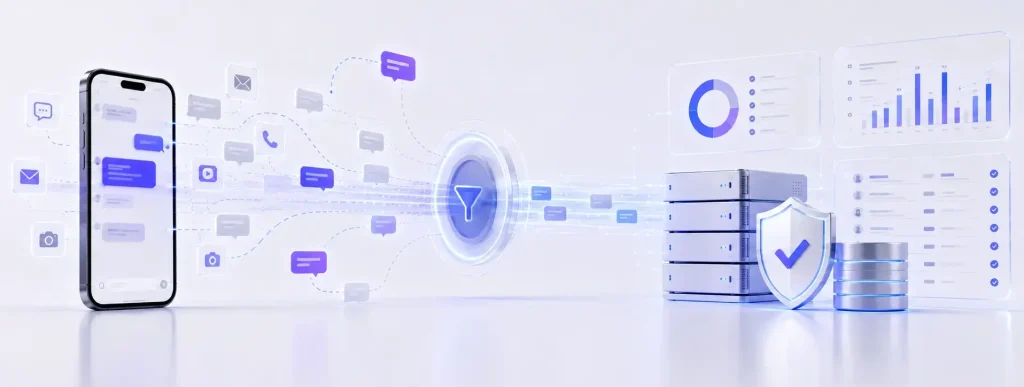
We compliantly capture SMS, iMessage, RCS, and WhatsApp business communications. Capture iMessage and RCS natively, with no app and no change to how people text, so blue bubbles, reactions, and media are all preserved. Capture WhatsApp Business and Messenger, in 1:1 and group chats, with no third-party app on the phone. On corporate-owned devices, capture business texts right at the carrier network, with nothing for employees to install. On personal phones, capture business texting through a secure app, keeping personal messages private.
A few honest boundaries keep expectations clear. Carrier capture runs on corporate-owned devices with a corporate billing plan, and it handles standard SMS, so iMessage and RCS are turned off on those lines. The personal-phone app uses a business number, new or the one already on the card, not the employee’s personal cell number, and it does not route through iMessage. WhatsApp capture covers messages, media, and metadata, not calls placed inside the app. We map these trade-offs with you, so each user lands on the right method.
Convert and deliver to the archive you already run
Whatever we capture, we convert to email format and deliver it to the journaling address of the archive you already trust, industry-leading archives like Intradyn, or any other. Nothing to rip out, nothing to refit. Each message arrives identified by type, with the employee side enriched with name, cell number, and corporate email, so you can supervise email and texts together in one search.
Match the right method to each user
Adoption is what actually ends off-channel drift, and the right method per user is what drives adoption. So we match carrier capture, native capture, and the personal-phone app to the people and devices in your firm, instead of forcing one shape on everyone. You can also centrally set and enforce an SMS disclaimer on captured lines, on the cadence you choose.
So you can close the off-channel gap without ripping out your archive or fighting your own people to use the tool.
The rules and enforcement behind off-channel communications
Accurate grounding matters more here than anywhere, so each rule below links to its primary source. Paraphrased plainly, here is what drives the obligation.
SEC Rules 17a-3 and 17a-4
Rule 17a-3 sets out the records a broker-dealer must create, and Rule 17a-4 sets out how long to keep them and how to preserve them (see our guide to capturing texts under SEC 17a-3 and 17a-4). Many records are kept for six years, with the two most recent years readily accessible. The 2022 amendments modernized the format, so a firm may now use a complete, time-stamped audit-trail system as an alternative to the older write-once-read-many approach, with records produced in a reasonably usable electronic form. Business communications fall squarely inside this, whatever device sent them. See the SEC’s electronic-recordkeeping amendment guide and the rule text. Registered investment advisers fall under a related retention rule, Investment Advisers Act Rule 204-2.
FINRA Rules 4511 and 3110
FINRA Rule 4511 requires member firms to make and preserve books and records, defaulting to at least six years where no other period applies, in a format that complies with the SEC preservation standard. FINRA Rule 3110 requires a supervisory system reasonably designed to achieve compliance, including the review of correspondence and internal communications (learn more about supervising texts under FINRA 3110). The two rules work as a pair. A firm cannot supervise what it cannot see, so messages have to be captured before they can ever be reviewed. Firms with commodities or EU activity also have parallel duties under CFTC Rule 1.31 and MiFID II, plus other applicable recordkeeping, retention, and supervision regulations (read more in our guide to FINRA 4511 retention).
Off-channel enforcement is active right now
This is not a theoretical risk. The SEC, joined by the CFTC, opened its off-channel communications initiative in 2021, looking at business messages sent on personal devices. Since then, more than 100 firms have been charged and over $3 billion in civil penalties paid for recordkeeping failures.
In one sweep on August 14, 2024, the SEC charged 26 firms with more than $390 million in combined penalties , and an earlier action on February 9, 2024 covered 16 firms and more than $81 million. Notably, regulators have pointed to firm-approved, captured messaging as the remedy. The message is not to ban mobile. It is to capture it properly.
Keep every business message on the record
Off-channel communications come down to a simple promise you make to regulators: the record is complete and you can produce it. The messages drifting across texts and chats are what quietly put that promise at risk. Close the gap with capture your people will actually use, delivered into the archive you already run, and an audit becomes routine instead of a scramble. A Solutions Team expert can map the right mix for your firm, and capture runs about a third the cost of an iPhone. Explore compliant archiving solutions on our solutions hub
This article is general information and education only, not legal or compliance advice. FINRA and SEC requirements change, and how they apply depends on your firm and situation. Confirm current obligations with your own qualified compliance or legal counsel and the primary regulations before you act.
FAQ’s
Frequently asked questions about off-channel communication
What counts as an off-channel communication?
Any business-related message sent on a channel the firm does not capture and supervise, commonly a text on a personal phone, an iMessage, or a WhatsApp chat. The test is whether the message is captured, not which app carried it. A business message the firm cannot produce is the core of the recordkeeping problem.
Does FINRA require firms to capture text messages?
In effect, yes. Business communications must be preserved under FINRA Rule 4511 and reviewed under FINRA Rule 3110, regardless of the device or app, so a business text carries the same duties as a business email. Confirm how the rules apply to your firm with your compliance counsel.
Do we have to ban WhatsApp, iMessage, and personal phones?
No. You can capture them. Regulators have pointed to firm-approved, captured messaging as the remedy rather than a blanket ban. We capture WhatsApp and iMessage, and we capture business texting on personal phones while keeping personal messages private, so the channels people prefer stay on the record.
How long must off-channel business communications be kept?
The same as other business records. Many are kept for six years, with the two most recent years readily accessible, under SEC Rule 17a-4, and FINRA Rule 4511 defaults to at least six years where no other period is set. Some records carry different periods, so confirm the specifics for your record types.
How do firms actually capture off-channel messages?
By matching a capture method to each user and channel, then delivering everything into the firm’s existing archive. Business texts can be captured at the carrier on corporate devices, on personal phones through a secure app, and natively for iMessage and WhatsApp. Each message is converted to email format and delivered to the archive you already run, so supervision happens in one place.
Start The Conversation
See the easily adopted, flexible, and affordable options.
Business-only, audit-ready mobile capture for any firm size, any device type, and any budget.
Related Guides
Rules, supervision, and capture guides
These guides go deeper on the rules, enforcement, and capture methods behind off-channel communications, so you can see how each obligation applies to the business messages your people send.
- Broker-dealer compliance The companion hub guide to a firm’s full recordkeeping duty, and where off-channel messages fit in.
- FINRA 3110 supervision The supervision rule that means you have to capture mobile messages before you can review them.
- FINRA 4511 retention requirements The books-and-records rule and the default six-year retention period for business texts.
- SEC 17a-3 and 17a-4 recordkeeping How the two SEC rules create and preserve records, and what the 2022 amendments changed for electronic formats.
- Archiving iMessage for business Why iMessage evades carrier capture, and how to preserve it in full for review.
- RIA compliance for texting How the same recordkeeping and supervision duties reach registered investment advisers.